Market ReportsMarch 31, 2026
Yankton vs Sioux Falls: Cost of Living Comparison 2026
By Michelle Maloney, Broker/Owner, Maloney Real Estate · SD License #14315
What is the Yankton vs Sioux Falls housing price gap in 2026?
Yankton median sale price is $241,000 per Redfin January 2026 data. Sioux Falls is $352,000 per Redfin. That is a $111,000 spread, or about 32 percent cheaper in Yankton. Days on market: 81 days in Yankton per Realtor.com, 47 days in Sioux Falls per Redfin. Active inventory: 154 listings in Yankton against roughly 800 in Sioux Falls per Realtor.com. Price per square foot: $141 in Yankton against $178 in Sioux Falls per Redfin. A 2,000 square foot new-build ranch runs around $280,000 in Yankton and $400,000 in the south suburbs of Sioux Falls.
How do property taxes compare?
Yankton effective property tax rate is 1.22 percent per the City of Yankton, Sioux Falls is 1.3 percent per the Minnehaha County Treasurer. On the respective median home prices, that is $2,940 a year in Yankton against $4,576 a year in Sioux Falls. Both cities are in South Dakota, which has zero state income tax per the South Dakota Department of Revenue, so the comparison is straight property tax only. That is a $1,600 annual difference on similar median homes, or $16,000 over 10 years. Not life-changing, but not nothing either if you are running the numbers.
Where Sioux Falls actually wins
Sioux Falls wins on three things and they matter if any of the three match your life. First, job count. Sanford Health alone employs about 15,000 people in the metro per Sanford Health. Sioux Falls has more tech jobs, more banking jobs (because of South Dakota usury laws), and more corporate headquarters than any other city in the state. Second, dining and entertainment volume. More than 200 restaurants in Sioux Falls against about 15 in downtown Yankton per TravelSD. Third, airline routes. Sioux Falls Regional has direct flights to Denver, Minneapolis, Chicago, Dallas, and Atlanta. Yankton has no airport. If your work or your life requires frequent flying or a specific Sioux Falls employer, the cost of living numbers do not matter. You live in Sioux Falls.
How do commutes and daily logistics compare?
Yankton average commute is 14 minutes per Realtor.com, Sioux Falls is 19 minutes per Realtor.com. Gas price averages $2.89 per gallon in Yankton per AAA. Yankton has no public transit, and most of Sioux Falls does not in a functional sense. Traffic: I-229 around Sioux Falls backs up at rush hour, especially near 41st Street and Louise Avenue. Yankton has one main commercial corridor (Broadway) and no rush hour to speak of. Lewis and Clark Lake is 10 minutes from downtown Yankton. Big Sioux Recreation Area is 45 minutes from central Sioux Falls.
What about grocery, utilities, and everyday costs?
Yankton cost of living index breaks down to housing 75, groceries 92, utilities 95, healthcare 93, and transportation 94 per Sperling's Best Places, all on a US average of 100. Sioux Falls runs higher on every line: housing 96, groceries 98, utilities 102, healthcare 96, and transportation 99. A family of four in Yankton spends about $450 a month at Hy-Vee against $480 in Sioux Falls per Consumer Price Index survey data. MidAmerican Energy bills in Yankton average $120 a month for electric against $140 on Xcel Energy in Sioux Falls per utility rate filings.
How do the schools compare?
Yankton School District 63-3 enrolls 3,036 students per the South Dakota Department of Education 2024-25 report. Graduation rate is 95 percent, math proficiency 46 percent, reading 57 percent. Sioux Falls School District enrolls 23,500 students per SD DOE. Graduation rate 89 percent, math proficiency 42 percent, reading 53 percent. Yankton numbers edge on every metric, but Sioux Falls offers more program depth: more AP courses, more sports, more specialized tracks like IB and dual-credit. If your kid is in the top or bottom 5 percent academically, Sioux Falls has specialized programs Yankton does not. If your kid is in the middle 90 percent, Yankton's tighter student-teacher ratio arguably matters more.
The structural difference nobody talks about
Sioux Falls is a growing city. Yankton is a stable city. That is not a criticism of either. It is a structural fact and it changes your real estate math. Sioux Falls adds about 3,200 residents per year per US Census 2023 ACS data, which is why housing appreciation there averages 5 percent annually per Zillow Home Value Index. Yankton grows about 50 residents per year, so appreciation is closer to 3 to 4 percent. If you are buying as a pure investment, Sioux Falls probably outperforms on appreciation alone. If you are buying a home to live in and do not plan to sell for a decade, Yankton's lower entry price and lower property tax cover the difference. And the lack of sprawl means downtown stays walkable and neighborhoods keep their character.
What does a family-of-four budget look like in each city?
In Yankton, a family of four can live on about $5,200 a month: $1,400 mortgage plus taxes on a $241,000 home, $350 utilities, $600 groceries, $250 gas, $300 internet and phone, $200 healthcare premiums, $200 entertainment, $1,000 discretionary. In Sioux Falls the same family spends about $6,100 a month on the same categories, roughly 17 percent higher, mostly driven by the $1,100 higher monthly mortgage payment on the median home. Numbers per Sperling's Best Places and the US Bureau of Labor Statistics 2024 Consumer Expenditure Survey.
Which one is right for you?
Simple rule. If your job is in Sioux Falls and requires in-person work, live in Sioux Falls or in the bedroom suburbs. The commute from Yankton is 60 minutes each way and you will hate it. If you work remotely, run your own business, are retired, or work for one of Yankton's large employers (Avera Sacred Heart, Mount Marty University, the Federal Prison Camp, or Yankton School District), Yankton gives you more house for the money, less traffic, and better schools at the median student level. If you need a bigger dating pool, more restaurant variety, or a regional airport within 15 minutes, Sioux Falls wins that debate easily. Most of the Minnesota and Iowa buyers I work with land on Yankton because they fall into the second group.
The lake difference is real
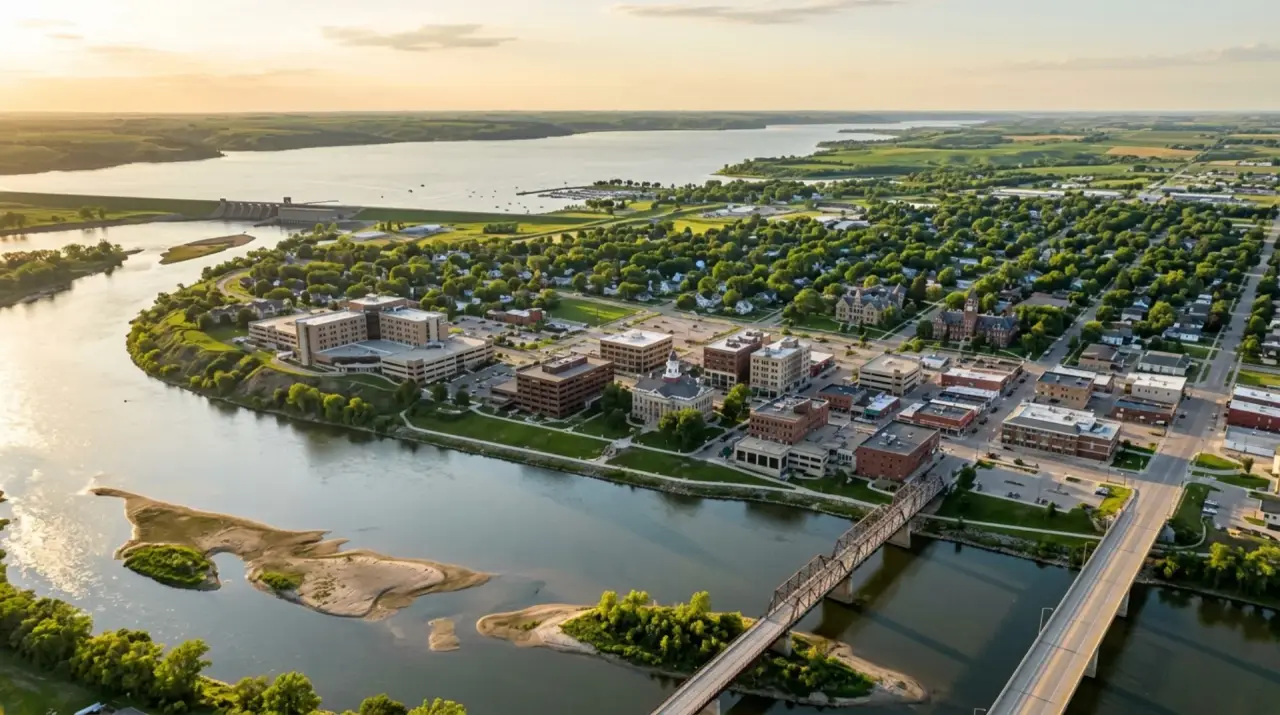
Both cities have water access, but the difference is bigger than it looks on a map. Yankton sits on the Missouri River, which forms the South Dakota-Nebraska border, and Lewis and Clark Lake (25 miles long, 31,400 acres per the US Army Corps of Engineers) starts 10 minutes from downtown. The marina has 400-plus wet slips and the recreation area has 418 campsites per South Dakota Game, Fish and Parks. Sioux Falls has the Big Sioux River, Falls Park downtown, and Big Sioux Recreation Area 45 minutes south. If you are a boater, fisher, or lake-house person, the two cities are not in the same tier. Yankton's lake is a daily destination. Sioux Falls's is a weekend one. For buyers from Minnesota or Iowa who want real water access without a three-hour drive to Brainerd, Yankton is the obvious pick.
What to do next
If you are genuinely choosing between the two cities, spend a long weekend in each. Book Friday to Sunday in each city back to back. Drive the neighborhoods you can afford, eat at three restaurants, and sit in traffic (or do not) during a weekday morning. Use the Yankton neighborhoods guide to pick which areas to tour. Read the living in Yankton guide for the daily-life details. If Yankton wins on the visit, the buyer guide covers the financing and offer part.
Market Reports
Yankton Real Estate Guide
Broad market context, neighborhoods, property types, and next-step paths.
Open guideMarket Reports
Homes for Sale
Use market context alongside live inventory.
Open guideMarket Reports
Cost of Living
Compare housing, taxes, and everyday costs in Yankton.
Open guide
About the Author
Michelle Maloney is the Broker/Owner of Maloney Real Estate in Yankton, South Dakota. She helps buyers and sellers understand the local market, compare their options, and make confident real estate decisions across Yankton and southeast South Dakota.
Sources
Redfin Yankton Housing Market, Redfin Sioux Falls Housing Market, Realtor.com Yankton County Market, Sperling's Best Places Yankton Cost of Living, Sperling's Best Places Sioux Falls Cost of Living, City of Yankton, Minnehaha County Treasurer, South Dakota Department of Revenue, SD DOE District Report Card, Sanford Health, US Census ACS Yankton and Minnehaha Counties, US Army Corps of Engineers Gavins Point Dam, South Dakota Game Fish and Parks.
Questions About the Yankton Market?
Ask Michelle's team about pricing, neighborhoods, timing, or your next move. No pitch, no pressure.