By Michelle Maloney, Broker/Owner, Maloney Real Estate · SD License #14315
How do appraisals count a finished basement in Yankton?
Separately, at least on an appraisal done under Fannie Mae or Freddie Mac guidelines. You’ll see the basement on the report, but not in the above-grade area.
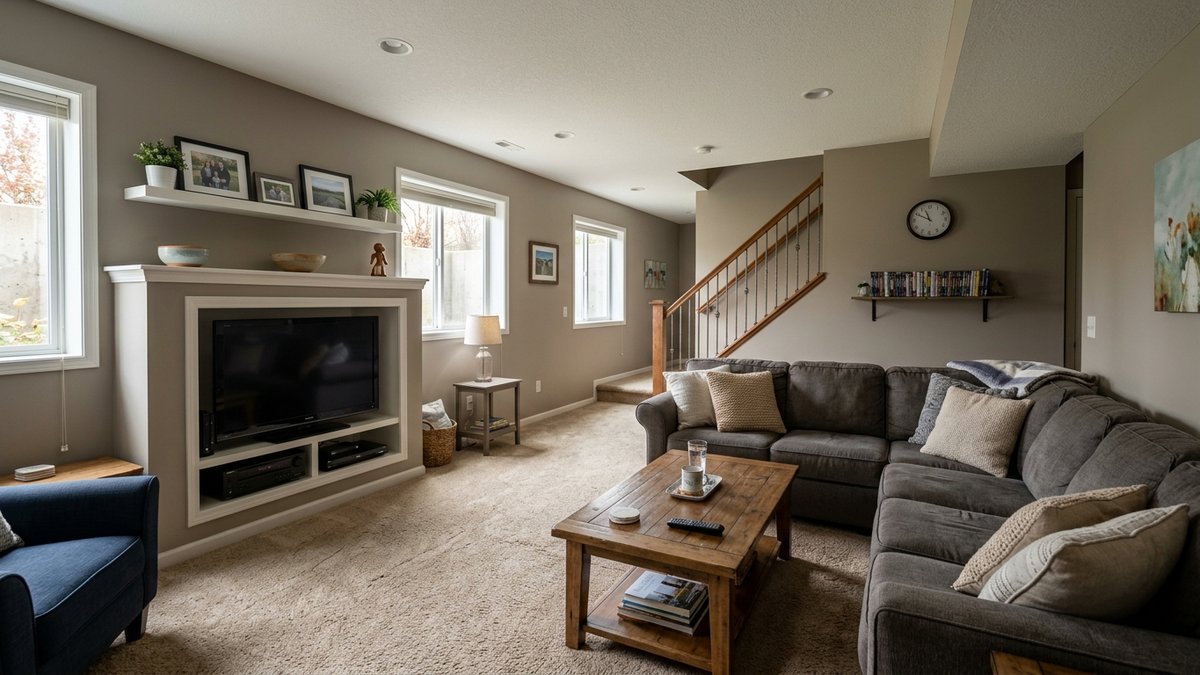
Fannie Mae’s Selling Guide says a level is below grade if any portion of it is below grade, regardless of how nice the finish is or how much window area a room has. Freddie Mac’s Guide says the same thing and adds that any below-grade area, finished or not, must not be included in the above-grade area. So a walk-out lower level with big windows onto the backyard still counts as below grade, because part of it sits below grade.
Those rules come from the two companies’ guides, so the first question for your lender is which guidelines your loan’s appraisal will follow. Ask it early, before you start comparing houses by their numbers. If you’re using an FHA loan, ask your lender how an FHA appraisal will report a finished basement and whether anything about the house you’re looking at could change that. Then share the answer with your agent, so you’re both comparing homes the same way.
The basement doesn’t disappear. Fannie Mae tells the appraiser to report below-grade areas separately, and Freddie Mac’s Guide gives finished and unfinished below-grade space their own labels on the report. Take a hypothetical ranch with 1,300 finished square feet on the main floor and a basement of the same size. In that basement, 1,000 square feet are finished rooms you reach without passing through unfinished space, with ceilings that meet the ANSI measuring standard’s height rules, and the other 300 are unfinished storage. Under those guidelines, the report would show 1,300 square feet finished above grade, 1,000 finished below grade and 300 unfinished below grade.
That example is the whole point for you. You could walk through 2,300 finished square feet in that house. The appraisal’s above-grade number would be 1,300.
Why can a listing and an appraisal tell different stories?
Because they’re answering different questions, and you need to know which one you’re reading.
When you’re comparing two homes on the Yankton homes for sale page, a listing’s total square footage or bedroom count may or may not include the basement. Don’t assume. Ask the listing agent how the number was figured and whether it includes the finished lower level.
The appraiser follows a specific method. For a house appraised with an interior and exterior inspection, Fannie Mae’s Selling Guide and Freddie Mac’s Guide both require the ANSI Z765 square footage standard for measuring, calculating and reporting the home’s finished and unfinished areas. Ask your lender what kind of appraisal your loan will get, since both guides tie the requirement to the kind of appraisal.
Low ceilings get their own label, too. Both Fannie Mae and Freddie Mac have the appraiser report finished area that doesn’t meet the ANSI ceiling height requirements as nonstandard finished area, separately, with the reason.
The same label covers a finished room you can only reach through an unfinished space, such as an unfinished hallway or staircase. Fannie Mae and Freddie Mac both list that case as nonstandard finished area and have the appraiser report it apart from regular finished space. So a nicely finished bedroom you can only reach by walking through an unfinished utility room gets reported as nonstandard finished area, not as regular finished space.
Freddie Mac’s Guide also spells out how each kind of space is named on the report: finished above grade, finished below grade, the nonstandard versions of each, and unfinished above or below grade. The Fannie Mae and Freddie Mac job aid uses the same categories. Both guides treat any part of the house that doesn’t meet the ANSI definition of finished area as unfinished. When you get your appraisal, find those lines first. They tell you how the appraiser saw the house you’re buying.
That matters for your offer. If you compare a ranch with a finished basement to a two-story with no basement by total square feet, you may be comparing two different kinds of space. The appraiser keeps them apart and reports them on separate lines. If your price only makes sense when every basement foot counts the same as the main floor, talk that through with your agent before you write. Our Yankton buyer guide walks through the rest of the buying steps.
Is a basement bedroom really a bedroom?
That depends on who’s asking. The listing, the appraisal and the city can each give you a different answer, and you want all three before you count the room.
On the appraisal side, the square footage is the clear part. Under Fannie Mae and Freddie Mac guidelines, a finished basement bedroom’s area goes on a below-grade line, not into the above-grade area. If you can only get to that bedroom through unfinished space, or its ceiling doesn’t meet the ANSI height rules, it’s reported as nonstandard finished area.
The bedroom count is the part to ask about. Ask your lender how the appraisal will count a bedroom on the basement level, and whether the bedroom total on the report will match the one on the listing. If you’re using an FHA loan, ask the same questions, and also ask whether the FHA appraiser can call a basement room a bedroom if it has no way out in an emergency.
The building code is a separate question from the appraisal. A room listed as a bedroom may or may not have been finished with a permit, and it may or may not meet the city’s code for a sleeping room. You can’t tell that from a listing photo. Ask the city.
What to ask the City of Yankton
Call the City of Yankton with the address and ask the building permit staff:
- Were building permits issued for finishing the basement, and when?
- Were those permits finaled after inspection?
- Does the basement sleeping room meet the city’s adopted code for emergency escape openings?
If you’re planning to put kids, guests or a renter downstairs, these answers matter more than the bedroom count on the listing. If the seller has the permit paperwork, ask for it with the disclosure documents.
What should you check before counting basement rooms?
Treat the basement like a separate line on your budget until you’ve confirmed it. A short list to run before you write:
- Ask how the listing measured. Does the square footage include the finished basement? Is the bedroom count above grade only, or does it include basement rooms?
- Walk it with the code question in mind. Look at each basement room listed as a bedroom. Is there a window or door you could get out of in an emergency? Write down what you see and take it to the city and your inspector.
- Ask the city about permits. Use the questions above.
- Ask your lender which guidelines your appraisal follows. If it’s an FHA loan, ask how the FHA appraisal handles basement square footage and basement bedrooms before you rely on either number.
- Have your inspector look closely. Ask about moisture, ceiling height and any window wells, and how each one affects the way you plan to use the space. If you’re new to what a South Dakota inspection covers, start with what to expect from a home inspection.
- Compare like with like. When you look at recent sales, separate above-grade and below-grade space the way the appraiser will.
- Read the area lines when the appraisal arrives. Check the finished above-grade, finished below-grade and unfinished numbers against what you walked through. If a number looks wrong, ask your lender how to raise it, and read what belongs in a Yankton appraisal error request before you write it up. Keep the request to facts you can show, like a room the appraiser missed or a measurement that doesn’t match the sketch.
If you’ve been weighing a finished attic or a one-level home against a basement layout, read finished attic checks for Yankton buyers and one-level or multi-level homes in Yankton next. Then decide which layout fits how you’ll actually live.
Frequently Asked Questions
Does an upstairs room that misses the ceiling height rules still count as a bedroom?
It can on an appraisal done under Fannie Mae or Freddie Mac guidelines. Fannie Mae's Selling Guide says appraisers should include rooms in above-grade nonstandard finished area, such as space that doesn't meet the ANSI ceiling height requirements, in the Total Rooms, Bedrooms and Bath(s) counts. Freddie Mac's Guide says the report must include those rooms in the same counts. The area itself is still reported separately as nonstandard.
Does a finished room over the garage count as part of the house?
It's reported separately if the only way in is through the garage. Fannie Mae's Selling Guide and Freddie Mac's Guide both treat finished area that's attached to the house with no direct interior access, and isn't designated as an accessory dwelling unit, as noncontinuous finished area. Both have the appraiser report it separately.
Does an older appraisal follow the same measuring rules?
Check its date. Freddie Mac's Bulletin 2023-15 and Bulletin 2023-16 both say its ANSI measuring requirement covers certain one-unit homes appraised with interior and exterior inspections and effective dates on or after November 2, 2023. If a seller shares an appraisal from before then, ask your lender how its square footage compares with what a new appraisal will report.
What if the basement was finished without a permit?
Don't guess at what that means for you. Ask the City of Yankton how it handles basement work done without a permit, have your home inspector look closely at that work, and talk with your agent about how to handle it in your offer.
Buyer Guides
Buy a Home in Yankton
The buyer service page for search help, offer strategy, and local guidance.
Open guideBuyer Guides
Yankton Buyer Guide
Step-by-step education for financing, inspections, offers, and closing.
Open guideBuyer Guides
Homes for Sale
Current inventory plus local search context by property type and area.
Open guide
About the Author
Michelle Maloney is the Broker/Owner of Maloney Real Estate in Yankton, South Dakota. She helps buyers and sellers understand the local market, compare their options, and make confident real estate decisions across Yankton and southeast South Dakota.
Sources
Fannie Mae Selling Guide B4-1.3-05, Improvements Section of the Appraisal Report (June 4, 2025), Freddie Mac Seller/Servicer Guide Section 5604.2, Exhibits for appraisal reports and PDRs (November 2, 2026), Freddie Mac Guide Bulletin 2023-15 (July 5, 2023), Freddie Mac Guide Bulletin 2023-16 (August 2, 2023), Fannie Mae and Freddie Mac, UAD ANSI Reporting Requirements job aid (June 23, 2026).
Questions About the Yankton Market?
Ask Michelle's team about pricing, neighborhoods, timing, or your next move. No pitch, no pressure.